
The question “who is the father of cricket” is one of the most inquired and talked-about topics among the cricket fans, students and sports history enthusiasts. Cricket is a game that has evolved over many centuries and while many people have played their part to grow the sport, one name stands above the others. To know who is father of cricket,one has to think beyond the records and statistics and see how this game became the modern sport as it is today. This article answers it in the simplest form, SEO-optimized and makes historical sense around what title originated from where, how did that influence society and what legacy continues today because of that title.
What Does “Father of Cricket” Mean?
Firstly, before answering this question, let us understand what the word refers to. The “father” of any sport may not have invented it, but he (and yes, all these fathers were male) was the one who formulated, popularized and codified it. In cricket’s instance, the sport took primitive forms long before its modern rules were penned. One man, however, was decisive in transforming cricket into a professional and globally admired sport. It is this contribution that results in historians and cricket boards calling one single figure when they are asked who the father of cricket is.
Some of the characteristics associated with cricket’s father are:
- Sports are always with us and they transform the world.
- Influencing playing techniques and professionalism
- Going to new heights for the public interest in seeing respect for
W. G. Grace – Nearly Universal Father of Cricket
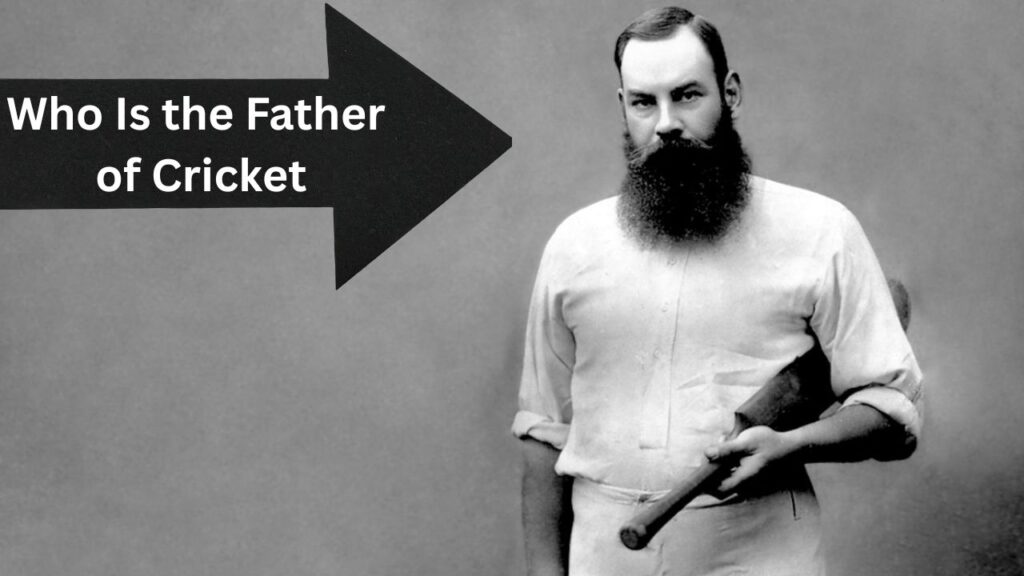
W. G. Grace is the most universally accepted name which pops when it comes to who is father of cricket. Born in 19th-century England, Grace all but changed cricket from the ground up. He was not merely a great player but an icon of cricket’s evolution into a contemporary sport. That made him the father of cricket because his dominance, longevity and impact on how the game was played and perceived were unparalleled.
Grace’s golden era of the game was rapid transformation. He linked the world of amateur cricket and that of professional competition, heightening the game’s discipline, competitiveness and spectator appeal. This is the most significant reason that historians all agree on who is father of
Early Life of W.G. Grace and his Family background
In order to fully understand who is the father of cricket, let’s take a look at his early life. W.G. Grace was born in 1848, in Gloucestershire (England) and came from a family deeply involved with cricket. His father, brother, two brothers and uncle were all regional cricketers from different counties, meaning that he was surrounded by it from an early stage of his life. The environment helped shape him not as merely playing cricket but also looking at it from several different viewpoints.
Grace’s batting was exceptional from an early age. His physical strength, hand-eye coordination and strategies while playing made him stand out even among older players. These early characteristics formed the basis for his later dominance, and explain why people still ask who is the father of cricket.
W.G. Grace changes the way we bat for ever
Why Grace is called the father of cricket: what are some of the reasons? One of these hath to be that his impact upon batting technique was so profound. Up until his day, batting had been mostly defensive. Thanks to Grace, a whole new realm of run-scoring possibilities was suddenly opened. He introduced attack shots and sturdy defence and thus made a complete reply throughout in how to tally runs.
His batting style Long-on and long-off shots straight bat hits to all parts of the ground– 6 ‘type of bat Practice the combine for driving by: when to do it with feet or body.
Then came the counter-attackTurning batting into an aggressive art form
Grace made hundreds of thousands of runs in an era of uncovered pitches and the crudest facilities for cricket. His way has never ceased to bear fruit down to the present day, inspiring generation after generation and laying the groundwork for all modern ideas about how to bat. Without that change, cricket would have forever remained a low-scoring, 90-minute game.
Contribution to Bowling and Fielding Standards
Most of the discussion about who is the father of cricket revolves around batting, but Grace had a great influence on both bowling and fielding. He was a competent bowler who knew how to vary his pace and length and place the ball to please himself. Even more valuable still, was the way he advocated fitness fielding for cricketers at a time when everyone else thought that fielding could safely be ignored.
- For cricketers to become agile, strong
- team play and self-discipline
New Standards set by him meant that cricket games were no longer a division of batting, merely complete contests. During his holistic coverage into organising and strengthening cricket he has dovetailed in great for the father of cricket outlook.
W. G. Grace and the Professionalization of Cricket
Another major reason why W. G. Grace is so often acknowledged as the father of cricket is that he was responsible for professionalising the game in his day. It was not yet the 19th century when cricket began to struggle with a split between amateurs and professionals. Grace, though nominally an amateur, gained a substantial income from cricket and endorsements, thereby establishing the practice of making a living at the sport.
With him at the helm cricket:
- Drew huge crowds to matches
- Increased press coverage of cricket
- Attracted both financial investment and sponsorship for cricket
This change saw cricket move past its island nation boundaries and persuaded gifted players everywhere in the world that they could indeed make a living as professionals.
Role in Making Cricket a Global Sport
When we evaluate who is the father of cricket, the global influence of a player cannot be ignored. What Grace did was not only significant because it had a huge effect on cricket within England. Then when England had colonies–like Australia, South Africa and India–he often out there his performance level (as high as it was at home). His matches received close attention, and his style was emulated. The school’s thirst for success comes from its former pupil.
Cricket boards and players all over the world modeled themselves after his example. This international effect is one reason why Grace may be crowned as the father of cricket.
Statistics That Justify The Claim
The legacy of effective batting and deadly fast bowling that W. G. Grace left behind cannot be entirely measured in statistics, but in his day what he achieved was extraordinary. Over 54,000 first-class runs, and nearly 3,000 wickets–these records stood for decades unchallenged.
Key Career Highlights
| Category | Achievement |
| First-class runs | 54,000+ |
| First-class centuries | 124 |
| First-class wickets | 2,800+ |
| Career span | Over 40 years |
These numbers show his dominance and longevity, reinforcing why he is remembered whenever people ask who is father of cricket.
Read also : Most Runs in ODI World Cup | World Famous Cricketer | India Cricket Schedule 2024-25
Title: Why No One Else Is Called the Father of Cricket
While there have been many players who have achieved legendary status, no one comes close to Grace’s overall influence on cricket. Early contributors to shaping cricket’s rules, and later players who helped to popularize it, few other figures were able to so fundamentally remake the sport at such a critical stage. This is why hardly any historians dispute who is the father of cricket: Grace simply stands alone in his role.
All players may be called pioneers or icons, but the title “father of cricket” belongs to the person who changed its course for good.
The Distinction between “Father of Cricket” and “God of Cricket”
“Father of Cricket” and “God of Cricket” are two distinctly different titles. The first refers to the historical development and foundation of cricket, while the second title is an honor modern-day enthusiasts give. Knowing this difference can help us eliminate erroneous ideas who historically made important contributions to the game of cricket.
Legacy of W. G. Grace in Today’s Cricket
W. G. Grace’s legacy in modern formats like Test cricket, one-day internationals and Twenty20 cricket is quite apparent even today. His training methods, coaching techniques and his approach to fielding continue to shape cricket.
Cricket schools, historians and commentators still quote Grace as they discuss the development of the game of cricket. The fact that his influence is long-lasting proves our point. It did not pass quickly but formed the very roots of modern cricket.
Last but not least: Who Is the Father of Cricket?
After checking the history, influence, statistics, and world-wide impact, it’s plain. WG Gu Race is the father of cricket. He turned it from a rough game for unprofessional amusement into a respected international sport followed by millions around earth today.
His influence reached everything cricket did in the 20th century except winning Olympic gold medals. and his personal triumph. We say that W G Gu Race is the father of cricket because in these ways he helped to give shape to cricket for generations.
To understand who is the father of cricket, those who value that sport must comprehend how it has evolved and why it occupies such an important place in global sports culture.
FAQs :
1. Who is known as the father of cricket?
The father of cricket is W. G. Grace. He has been known as such for his record in shaping and popularizing the modern game.
2. Why is W. G. Grace called the father of cricket?
Grace transformed cricket with his styles of batsmanship and professionalism, raising fitness standards. He also helped to make cricket a sport that is so popular throughout the world today.
3. Did W. G. Grace invent cricket?
No, Grace didn’t invent cricket. He only modernized and standardized it–that’s how he became known as the father of cricket.
4. When did W. G. Grace play cricket?
He played cricket at an international and first-class level mainly during the late 19th and early 20th centuries.
5. Is the father of cricket different from the God of cricket?
Yes, cricket’s father refers to its historical development, while God of cricket is a modern honorary title based on popular taste and merit.
Read also : How Many Countries Play Cricket | World Fastest Bowler Ranking 2026 | World Fastest Bowler